EUR/USD Technical Analysis: Relief Bounce Begins, but Sellers Still Control the Larger Trend
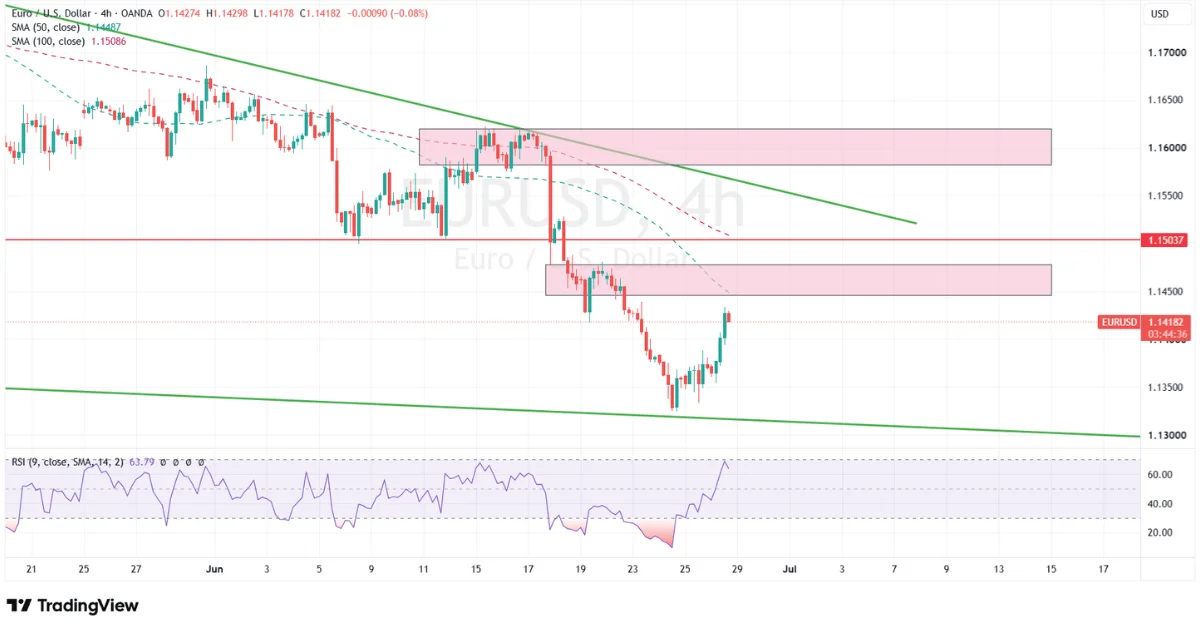
EUR/USD has started to recover after a sharp decline toward the 1.1320–1.1350 area. The rebound is visible on both the daily and 4-hour charts, but the broader technical structure remains bearish.
The pair is trading near 1.1420 after bouncing from the lower side of a descending channel. This is an important reaction area because buyers defended the lower trend support and the RSI moved up from deeply oversold conditions.
However, the bounce has not yet changed the main trend.
EUR/USD remains below its 50-day and 100-day moving averages, while the 4-hour chart shows strong overhead supply between 1.1445 and 1.1475. Above that, the larger resistance zone sits near 1.1580–1.1615.
For now, the recovery looks more like a corrective bounce inside a broader downtrend rather than a confirmed bullish reversal.
Daily Chart: EUR/USD Holds Lower Channel Support
The daily chart shows EUR/USD reacting from the lower boundary of a descending channel.
The recent fall pushed price below the important 1.1500 support zone and toward the 1.1330 area. That decline confirmed that sellers had taken control after the pair failed repeatedly around the 1.1600–1.1650 region.
The current rebound is technically important because the pair has moved back above the immediate 1.1400 area. But price remains well below the 50-day moving average near 1.1620 and the 100-day moving average near 1.1647.
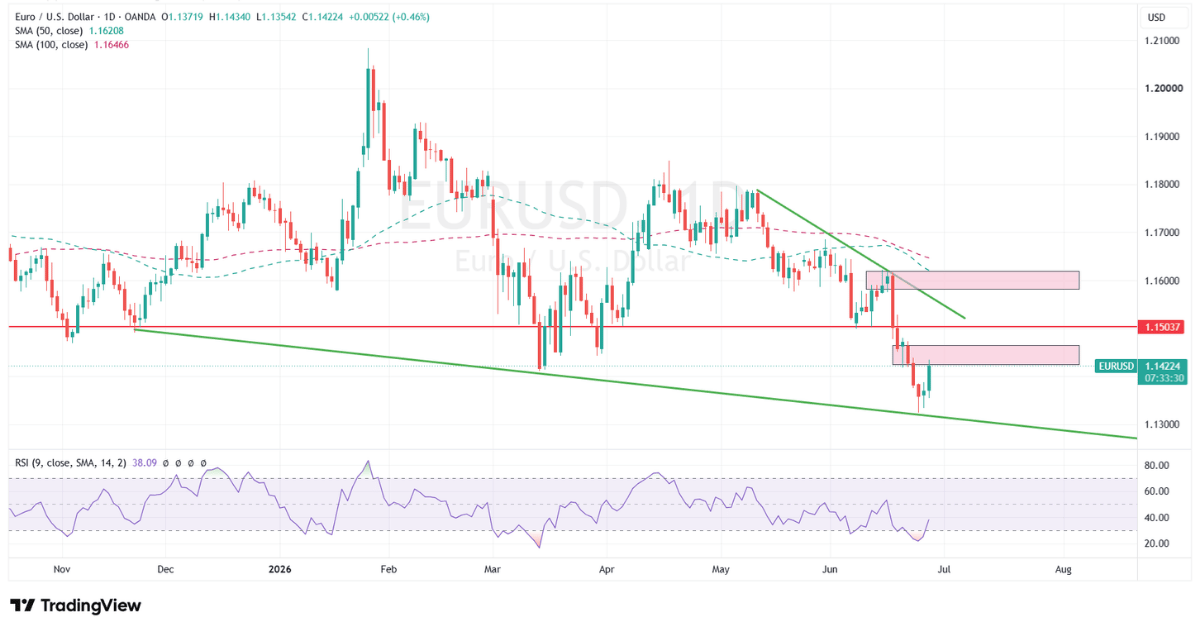 These averages are now acting as major long-term resistance.
Until EUR/USD recovers above these levels, the larger structure remains negative.
The daily RSI has also improved from oversold territory, but it remains below the neutral 50 area. This suggests that bearish momentum has eased, but buyers have not yet taken full control.
4-Hour Chart: Recovery Faces Its First Real Test
The 4-hour chart shows a stronger short-term recovery.
EUR/USD bounced sharply after reaching the 1.1320–1.1340 region. The RSI recovered from below 20 and has now moved above 60, showing that short-term buying momentum has improved.
However, this creates a new challenge.
The first major supply area is between 1.1445 and 1.1475. This zone is close to the 4-hour 50-period moving average and the lower edge of a previous breakdown area.
If EUR/USD fails in this region, sellers may return quickly.
The next resistance sits near 1.1504. This level was previous support and is now a key breakdown level. A sustained move above 1.1504 would be the first real sign that the current recovery is becoming more than a temporary bounce.
Above that, the larger 4-hour supply zone remains between 1.1580 and 1.1615.
Key Support Levels
The first support is now around:
1.1400–1.1380
This is the immediate area that buyers need to defend to keep the short-term rebound alive.
Below that, the next important support is:
1.1350–1.1320
This was the recent reaction low and sits close to the lower channel boundary. A break below this zone would weaken the recovery and bring the bearish trend back into focus.
The next downside levels are:
1.1300
1.1275
1.1200
A clean daily close below 1.1320 could open the way toward the 1.1300 psychological level.
Key Resistance Levels
The first major resistance area is:
1.1445–1.1475
This is the immediate zone to watch on the 4-hour chart.
The next key level is:
1.1504
This former support level is now important resistance. EUR/USD needs to reclaim it to reduce the short-term bearish pressure.
Above 1.1504, the next major resistance levels are:
1.1580–1.1615
1.1620
1.1645–1.1650
The 1.1620–1.1650 area is especially important because it includes the daily 50-day and 100-day moving averages. A move above that zone would significantly improve the medium-term outlook.
Until then, rallies may continue to attract sellers.
Fundamental Outlook: ECB Supports EUR, but USD Remains Strong
The euro has support from the ECB’s hawkish policy outlook.
Eurozone inflation remains above the ECB’s target, while services inflation remains sticky. This keeps pressure on the ECB to remain cautious and leaves the possibility of further tightening later in the year.
That is a positive factor for the euro.
However, EUR/USD is not only an ECB story.
The U.S. Dollar remains supported by stronger U.S. growth, firm consumer spending and a Federal Reserve that is not ready to turn dovish. Recent U.S. data showed that the economy remains resilient, reducing the need for the Fed to ease policy quickly.
This creates a difficult environment for EUR/USD.
The ECB may still be hawkish, but the Fed is also not giving up its restrictive policy stance. As long as U.S. yields remain firm, the Dollar can continue to limit EUR/USD upside.
What Could Support a Larger EUR/USD Recovery?
EUR/USD would need a combination of technical and fundamental improvement.
The bullish case becomes stronger if:
The pair holds above 1.1400
EUR/USD breaks above 1.1475
Price reclaims 1.1504
U.S. Treasury yields fall
The Dollar weakens after softer U.S. inflation or jobs data
ECB officials maintain a strong tightening bias
Eurozone inflation remains firm
Risk sentiment improves without a major return of energy-price stress
A sustained move above 1.1504 could open the way toward 1.1580–1.1615.
A stronger break above 1.1650 would be needed to repair the larger daily bearish structure.
What Could Restart the Downtrend?
The bearish case remains active while EUR/USD trades below 1.1504 and well below the daily moving averages.
The downside scenario becomes stronger if:
EUR/USD fails below 1.1445–1.1475
The Dollar strengthens after strong U.S. data
Treasury yields rise
Fed policy remains restrictive
Eurozone growth weakens
Oil prices rise again and hurt Europe’s terms of trade
The pair breaks below 1.1350–1.1320
A break below 1.1320 could expose 1.1300 and then lower channel targets near 1.1275.
What Traders Should Watch in the Coming Weeks
The next major direction will likely depend on the battle between ECB tightening expectations and the U.S. Dollar.
For the euro, traders should watch eurozone inflation, services inflation, wage data and comments from ECB officials.
For the Dollar, the key drivers will be U.S. PCE inflation, employment data, consumer spending, Treasury yields and Federal Reserve guidance.
The technical levels are equally important.
A recovery above 1.1504 would improve the short-term outlook.
A failure below 1.1475 would keep the bounce fragile.
A break below 1.1320 would confirm that sellers remain in control.
BonusPips View
EUR/USD has produced a strong relief bounce after reaching the lower side of its descending channel. The short-term recovery is supported by a sharp RSI rebound and a defence of the 1.1320–1.1350 zone.
But the larger structure remains bearish.
The pair is still below its daily moving averages and remains under important resistance at 1.1445–1.1475 and 1.1504.
Fundamentally, the ECB gives the euro support through its hawkish inflation stance. However, stronger U.S. growth, firm consumer demand and a still-cautious Fed continue to support the Dollar.
The key message is simple:
EUR/USD can recover further in the short term, but the broader trend remains bearish until price reclaims 1.1504 and then breaks above the 1.1580–1.1650 resistance area.
For now, the 1.1400 level is the first support to watch, while 1.1445–1.1475 is the first major resistance zone that buyers must overcome.



0 Comments