EUR/USD Technical Analysis: Recovery Stalls Near Key Resistance as Fed Week Begins
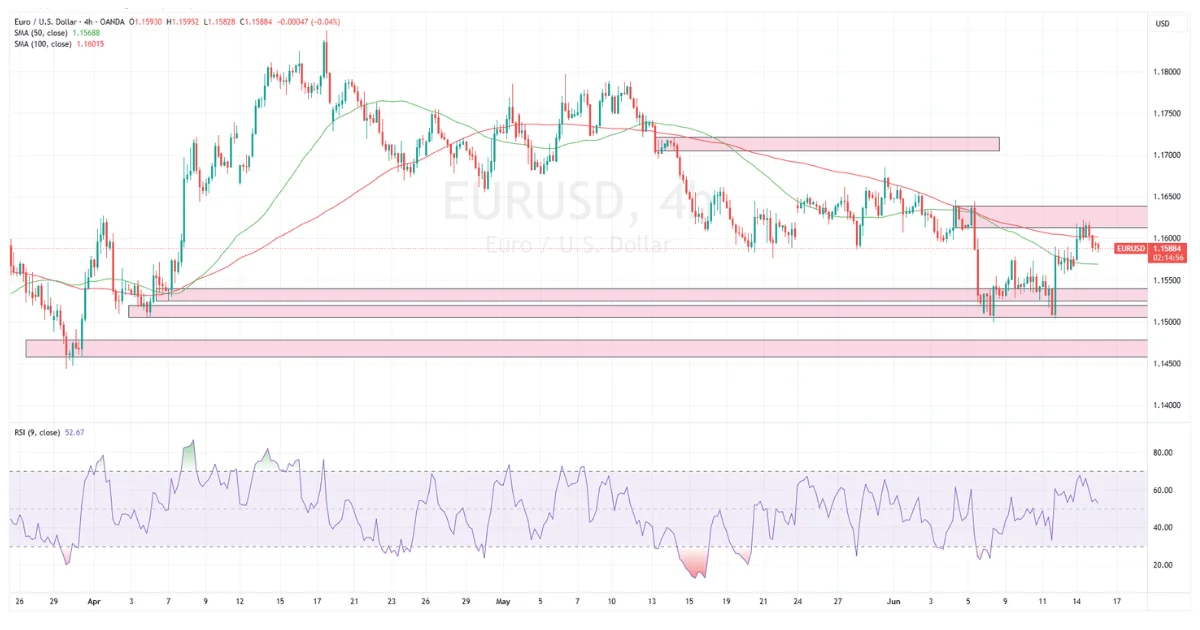
EUR/USD is trading around the 1.1580–1.1600 area after recovering from the recent support zone near 1.1500–1.1520. The pair has bounced from the lows, but the recovery is now facing resistance near an important technical area.
The 4-hour chart shows that EUR/USD is trying to stabilize after a sharp breakdown earlier in June. However, the pair is still struggling below the 100-period SMA, and buyers have not yet confirmed a strong bullish reversal.
Fundamentally, the euro is supported by a hawkish European Central Bank, but the U.S. Dollar is still backed by Fed expectations, Treasury yields and safe-haven flows. This makes EUR/USD a two-sided market.
The next major move will likely depend on whether the pair can break above 1.1620–1.1640, or whether sellers return and push price back toward 1.1520.
Current Technical Picture
EUR/USD is currently trading near 1.1588.
The pair recently bounced from a strong support area around 1.1500–1.1520, which has acted as an important demand zone several times on the chart. Buyers defended this area and pushed price back toward the 1.1600 region.
However, the recovery is now slowing.
Price is trading close to the 50-period SMA near 1.1568, but still below the 100-period SMA near 1.1601. This means the short-term structure has improved, but the broader 4-hour bias has not yet turned fully bullish.
A clean break above the 100 SMA would be an important signal that buyers are trying to regain control.
Key Resistance Levels
The first important resistance is around:
1.1600–1.1620
This zone includes the 100-period SMA and the latest reaction area. If EUR/USD can break and hold above this zone, buyers may attempt to push toward the next resistance around 1.1635–1.1645.
The next major resistance is around:
1.1700–1.1720
This is a stronger supply zone from earlier price action. A move into this area may attract sellers again unless the fundamental picture strongly supports the euro.
Above that, the next major resistance is around:
1.1750–1.1780
This is where the previous bullish structure failed before the larger pullback started.
For now, EUR/USD needs to clear 1.1620–1.1640 first before the market can talk about a larger recovery.
Key Support Levels
The first support is around:
1.1560–1.1550
This is close to the 50-period SMA and recent intraday structure. If price holds above this zone, the recovery attempt remains alive.
Below that, the most important support remains:
1.1520–1.1500
This is the main demand zone on the chart. A break below this area would be bearish and could open the door toward the next support around 1.1460–1.1480.
If EUR/USD loses 1.1500, the market may shift back into a stronger bearish structure.
RSI Shows Neutral Momentum
The RSI is around 52, which shows neutral momentum.
This is important because EUR/USD is not overbought and not oversold. The pair has room to move in either direction.
A move above 60 on RSI would support the bullish recovery case. A drop below 45 would show that buyers are losing momentum again.
At the moment, RSI confirms consolidation rather than a clear trend.
Bearish Structure Still Not Fully Repaired
Even though EUR/USD has bounced, the broader 4-hour chart still shows lower highs from the May peak.
The pair sold off sharply from the 1.1750–1.1780 area and later broke below intermediate support around 1.1600–1.1640. That broken support is now acting as resistance.
This is why the current zone is very important.
If EUR/USD fails near 1.1600–1.1640, the recovery may only be a correction inside a bearish structure.
If EUR/USD breaks above this zone, it would show that buyers are starting to repair the breakdown.
Fundamental Background
The fundamental picture is mixed.
The European Central Bank recently raised rates by 25 basis points, taking the deposit rate to 2.25%. ECB officials continue to warn that inflation pressure has not fully disappeared, especially because energy prices and services inflation can still create second-round effects.
This gives the euro some support because markets believe the ECB may need to keep policy tight.
However, the U.S. Dollar is also not weak.
The Federal Reserve is expected to keep rates on hold this week, but the market will focus heavily on the Fed statement, projections and press conference. If the Fed keeps a higher-for-longer message, the Dollar may recover and pressure EUR/USD.
The U.S.-Iran peace framework has also affected the market. Lower geopolitical risk has reduced some safe-haven demand for the Dollar, but the Dollar may remain supported if U.S. yields stay firm.
This is why EUR/USD is stuck between a hawkish ECB and a still-cautious Fed.
Impact of the Iran Peace Deal
The U.S.-Iran peace framework has helped improve risk sentiment.
Oil prices have pulled back from war-risk highs, which may reduce inflation pressure globally. This can support equities and risk-sensitive assets, while reducing safe-haven demand for the Dollar.
For EUR/USD, this is mildly supportive because a softer Dollar can help the pair recover.
However, the peace deal is not fully risk-free. If implementation becomes uncertain or Hormuz tensions return, the Dollar may regain safe-haven demand.
This means EUR/USD remains sensitive to both central bank headlines and geopolitical updates.
Fed Week: Why It Matters for EUR/USD
The FOMC decision is the biggest event for EUR/USD this week.
The rate decision may not be the main surprise because the Fed is expected to hold. The real driver will be the tone.
If the Fed sounds hawkish, EUR/USD may fall because the Dollar would likely strengthen.
If the Fed sounds balanced or less concerned about inflation, EUR/USD may recover because yields could fall and the Dollar may weaken.
Traders should watch:
Fed economic projections
Inflation forecasts
Dot plot guidance
Powell’s tone
U.S. Treasury yields
Dollar index reaction
The post-FOMC reaction may decide whether EUR/USD breaks above resistance or returns to support.
Possible Bullish Scenario
The bullish scenario needs a clean break above 1.1620–1.1640.
If price closes above this zone, EUR/USD may move toward 1.1700–1.1720. A stronger move above 1.1720 could open the way toward 1.1750–1.1780.
This scenario becomes stronger if:
The Fed sounds less hawkish
U.S. yields fall
The Dollar weakens
ECB officials remain hawkish
Risk sentiment stays positive
Oil prices remain under control
In this case, EUR/USD may continue its recovery from the 1.1500 support area.
Possible Bearish Scenario
The bearish scenario remains active if EUR/USD fails below 1.1620–1.1640.
If sellers defend this zone and price falls below 1.1550, the pair may return toward 1.1520–1.1500.
A break below 1.1500 would be a strong bearish signal and may expose 1.1460–1.1480.
This scenario becomes stronger if:
The Fed sounds hawkish
U.S. yields rise
The Dollar strengthens
Risk sentiment weakens
The Iran peace deal faces problems
EUR/USD fails near the 100 SMA
In this case, the recent bounce may turn into another selling opportunity.
BonusPips View
EUR/USD is at an important short-term decision point.
The pair has bounced from the 1.1500–1.1520 demand zone, but the recovery is now testing resistance near 1.1600–1.1640. The 100-period SMA is also sitting in this area, making it an important barrier for buyers.
Technically, EUR/USD needs a clean break above 1.1640 to confirm that the recovery is gaining strength. Without that break, sellers may return and push the pair back toward 1.1520 and 1.1500.
Fundamentally, the euro has support from a hawkish ECB, but the Dollar remains sensitive to the Fed, Treasury yields and safe-haven demand.
The key message is simple:
EUR/USD is recovering, but it has not yet confirmed a bullish reversal. A break above 1.1640 can open the way toward 1.1700, while failure below this zone keeps downside risk alive.
For traders, this is a week to watch confirmation. The Fed decision and post-FOMC Dollar reaction may decide the next major direction for EUR/USD.

0 Comments