EUR/USD Outlook: Euro Recovery Faces a Key Test as US Jobs and Eurozone Inflation Come Into Focus
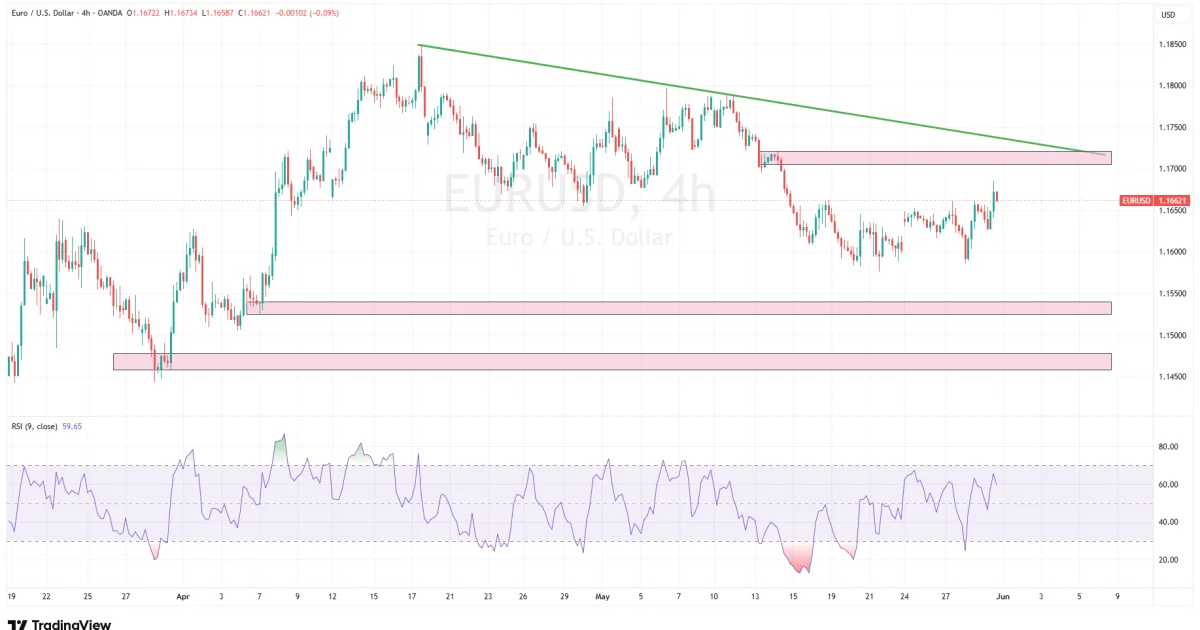
EUR/USD is entering the new week at an important technical and fundamental point. The pair has recovered from the recent lows, but it is still trading below a major resistance trendline on both the 4-hour and daily charts. This means the market is trying to rebuild bullish momentum, but buyers still need confirmation before the recovery can be trusted.
From a fundamental side, the next move in EUR/USD will likely depend on two major themes: Eurozone inflation and U.S. economic data. The pair is currently trading between two central bank stories — the European Central Bank is still dealing with sticky inflation, while the Federal Reserve remains cautious because U.S. inflation and labor data are not weak enough to justify aggressive easing.
Fundamental Outlook: EUR and USD Both Have Key Tests Ahead
The Euro has recently found some support as traders continue watching inflation pressure in the Eurozone. If inflation remains firm, the market may expect the ECB to keep policy tighter for longer. That could help the Euro recover further.
However, the Eurozone economy is still not showing strong growth momentum. This makes the ECB’s job difficult. If inflation stays high while growth remains weak, the Euro may struggle to gain strong upside traction.
For the U.S. Dollar, the focus remains on the Federal Reserve. The Dollar has recently been supported by higher-for-longer rate expectations, but it has also lost some ground whenever U.S. data shows signs of cooling.
This week is important because traders will watch major U.S. reports, including:
- ISM Manufacturing PMI
- ISM Services PMI
- ADP Employment
- Fed Beige Book
- Non-Farm Payrolls
- Average Hourly Earnings
- Unemployment Rate
If U.S. data comes stronger than expected, the Dollar could regain strength and push EUR/USD lower. If the data disappoints, EUR/USD could extend its recovery.
For the Euro side, traders should watch:
- Eurozone inflation data
- German economic signals
- ECB comments
- European bond yields
- Risk sentiment in global markets
The key question is simple:
Will Eurozone inflation keep the ECB cautious, or will U.S. data keep the Fed more hawkish than the ECB?
That answer will likely decide the next bigger move in EUR/USD.
EUR/USD Technical Analysis – Daily Chart
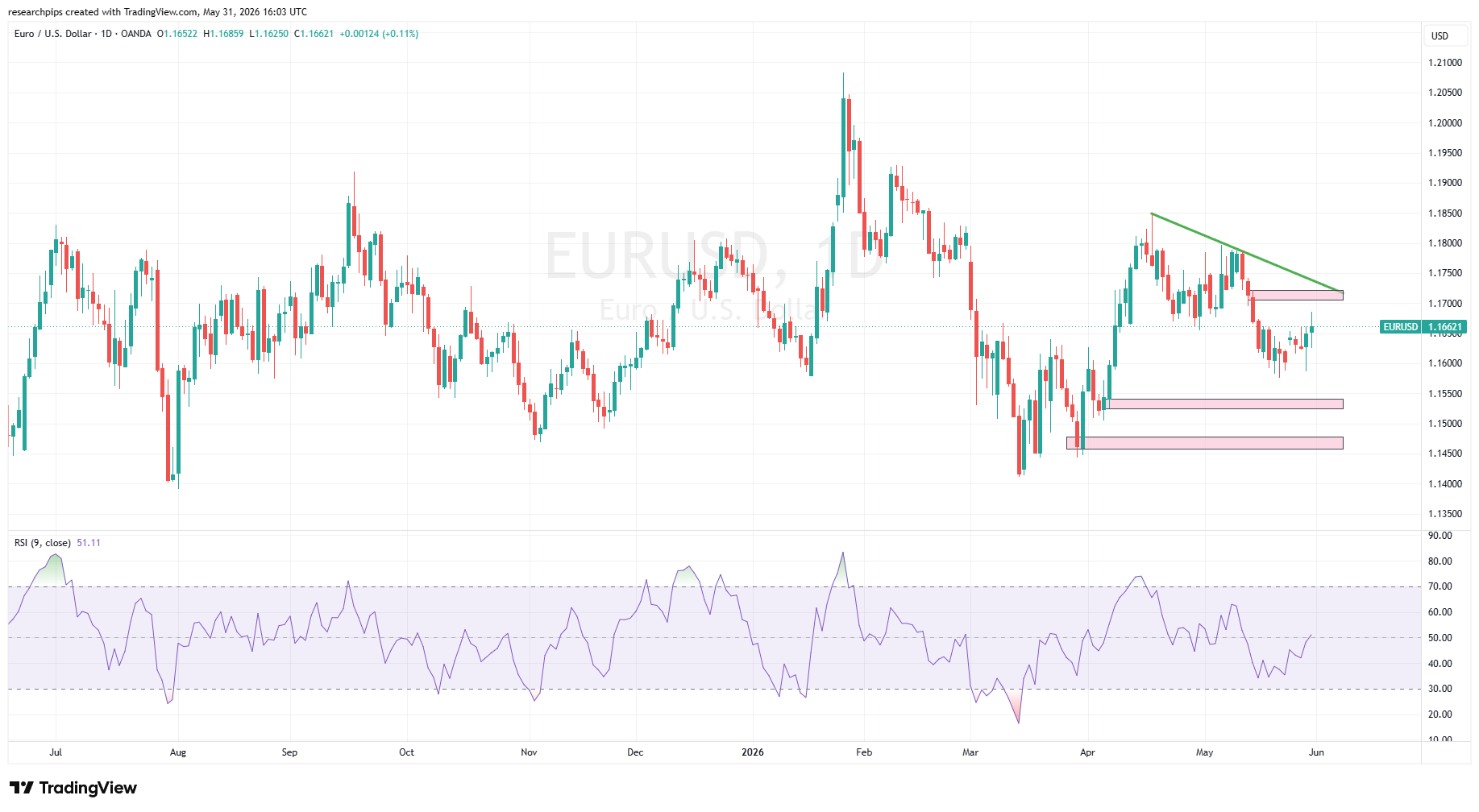
On the daily chart, EUR/USD is showing a recovery attempt after finding support around the 1.1450–1.1500 region.
This area remains an important demand zone. Buyers defended it strongly, and the pair has now moved back toward the 1.1650–1.1700 region.
However, the daily chart also shows a descending trendline from the recent highs. This trendline is now acting as a major resistance area near:
1.1700 – 1.1750
Until EUR/USD breaks above this zone clearly, the broader recovery remains incomplete.
The RSI on the daily chart is around the neutral area, suggesting that momentum has improved but is not yet strongly bullish. This supports the idea that the pair is in a recovery phase, but buyers still need a breakout for stronger confirmation.
Daily chart levels to watch:
 Resistance:
- 1.1700
- 1.1750
- 1.1800
- 1.1850
Support:
- 1.1600
- 1.1500
- 1.1450
- 1.1100 longer-term demand zone
A daily close above the descending trendline could shift the structure more bullish and open the way toward 1.1800 and higher. Failure below that trendline may keep EUR/USD trapped in a corrective range.
EUR/USD Technical Analysis – 4-Hour Chart
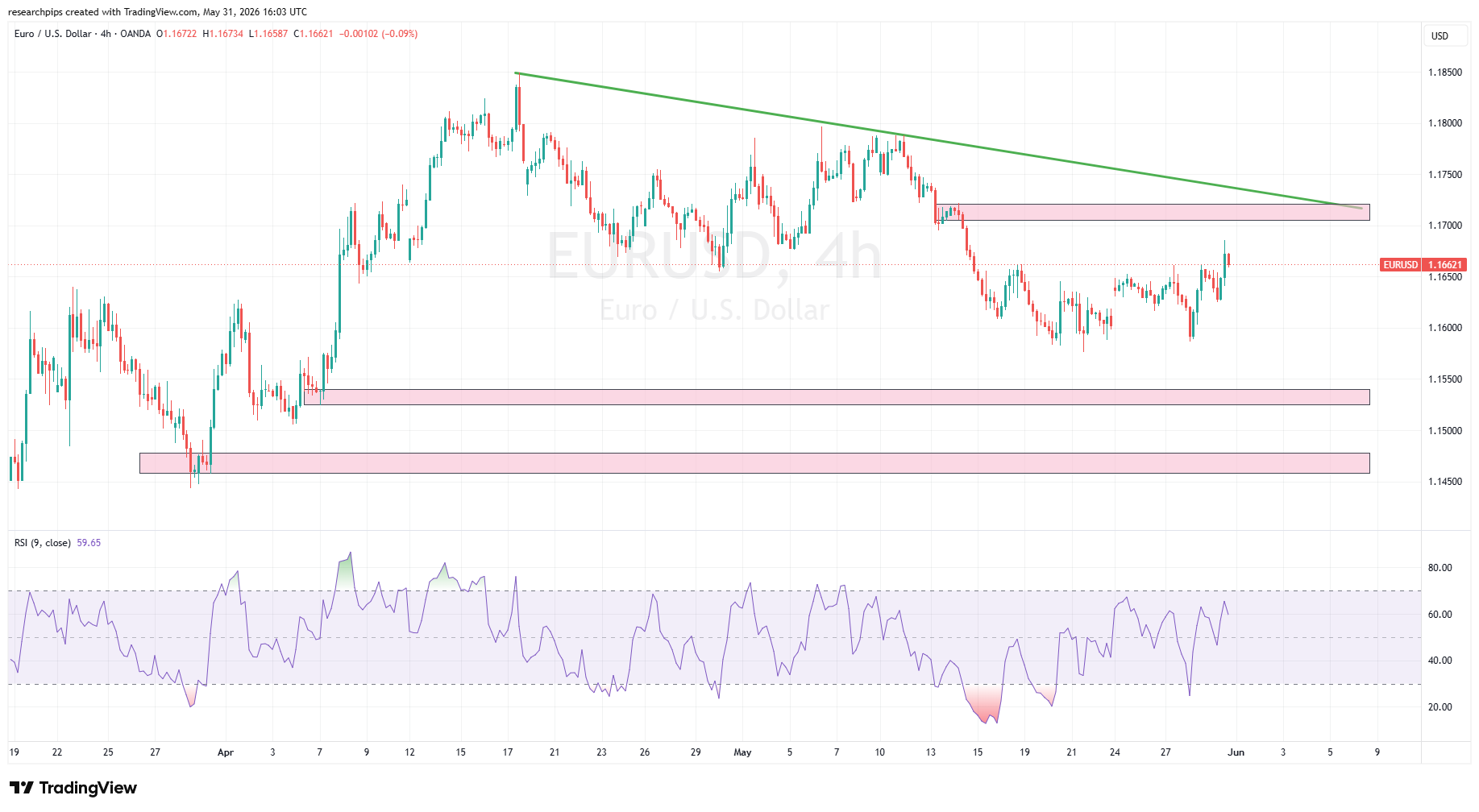
The 4-hour chart gives a more detailed view of the short-term structure.
EUR/USD recently broke higher from the local base around the 1.1580–1.1600 area and moved toward 1.1660–1.1680. This shows that buyers are trying to regain control after the previous selloff.
However, the pair is now approaching a key resistance area. The chart shows previous supply zones near:
1.1700 – 1.1720
Above that, a stronger resistance area remains around:
1.1770 – 1.1790
The descending trendline on the 4-hour chart also aligns with the upper resistance zone, making it an important area for sellers.
The RSI on the 4-hour chart is near 60, which shows improved bullish momentum. However, it is not yet overbought, meaning there is still room for upside if buyers manage to break resistance.
4-hour chart levels to watch:
 Immediate resistance:
- 1.1680
- 1.1700
- 1.1720
Major resistance:
- 1.1770
- 1.1800
Immediate support:
- 1.1630
- 1.1600
- 1.1580
If price holds above 1.1600, buyers may try another push higher. But if EUR/USD falls back below 1.1600, the recovery may weaken and sellers could target 1.1550 and 1.1500 again.
What Could Decide EUR/USD This Week?
This week, EUR/USD may be highly sensitive to data surprises.
The main bullish scenario for EUR/USD would be:
- Softer U.S. ISM data
- Weaker U.S. jobs numbers
- Lower wage growth
- Stronger Eurozone inflation
- Less hawkish Fed expectations
- Softer U.S. Treasury yields
The bearish scenario would be:
- Strong U.S. ISM data
- Strong NFP and wage growth
- Sticky U.S. inflation expectations
- Weak Eurozone inflation
- Hawkish Fed pricing
- Higher U.S. Treasury yields
In simple terms, EUR/USD needs either a stronger Euro story or a weaker Dollar story to break higher.
BonusPips View
EUR/USD is trying to recover, but the pair is not fully bullish yet.
Technically, price has bounced from support and short-term momentum has improved. However, the pair is now heading into an important resistance area near 1.1700–1.1750. A clean breakout above this zone could open the door for a move toward 1.1800 and possibly 1.1850.
Fundamentally, the pair remains data-driven. The Euro may gain support if Eurozone inflation stays firm, but the U.S. Dollar can regain control quickly if U.S. jobs and ISM numbers come in strong.
For now, the market setup is balanced:
EUR/USD recovery is possible, but buyers need a breakout above resistance to confirm strength.
Until that happens, traders should watch the 1.1700–1.1750 area very closely. This zone may decide whether EUR/USD continues higher or turns lower again.



0 Comments