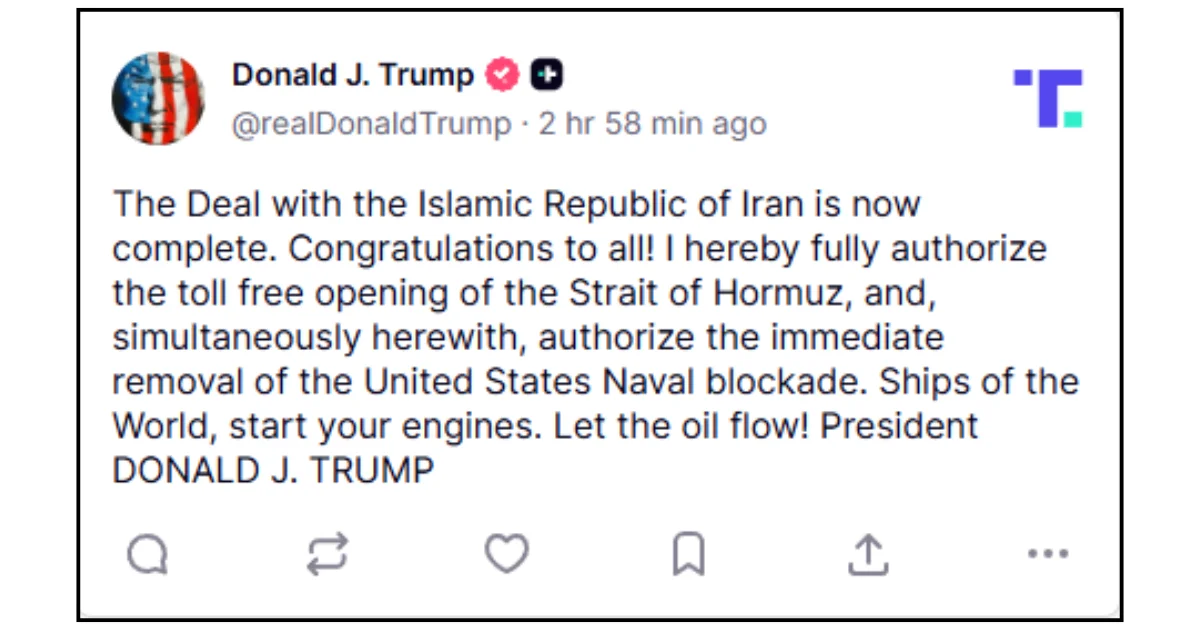
Markets Start the Week With Peace Deal Optimism, but Gold and Oil Remain Highly Sensitive
Markets started the week with a major shift in sentiment as hopes for a U.S.-Iran peace deal triggered a sharp reversal across global assets.
After days of heavy war headlines, U.S. strikes, Iranian warnings, Hormuz disruption and oil supply fears, traders suddenly moved into a more optimistic mood. The peace-deal headlines created a broad risk-on reaction. Equities improved, oil moved lower, the U.S. Dollar softened, Treasury yields eased, and gold bounced from deeply oversold levels.
However, the market is not treating this as a fully completed peace agreement yet.
The current deal appears to be more of a framework or memorandum of understanding rather than a final settlement. That means markets are pricing relief, but not full certainty. The next few days will be important because traders will want confirmation that Hormuz traffic normalizes, both sides accept the terms, and the military escalation does not return.
How the Week Started
The week started with a clear shift away from panic and toward diplomacy.
Markets had been under pressure after repeated U.S. strikes on Iranian targets and reports of missile activity from Iran. Oil had been supported by fears that the Strait of Hormuz could remain restricted or disrupted. Gold had fallen sharply because Dollar strength, high yields and Fed-rate expectations were overpowering safe-haven demand.
Then the peace-deal headlines changed the tone.
Reports suggested that the U.S. and Iran were moving closer to an agreement that could reduce military pressure, reopen Hormuz and create a path for further negotiations.
This immediately created a classic relief move across markets.
Oil dropped because the supply-risk premium started to fade. Stocks moved higher because investors saw lower geopolitical risk. The Dollar softened because safe-haven demand reduced. Gold bounced because yields eased and some short-covering entered the market after a large sell-off.
What the Peace Deal Appears to Mean
The deal is not yet a simple “war is over” moment.
The market is currently looking at it as a framework that may allow both sides to step back from immediate escalation. The possible structure appears to include U.S. commitments around easing military pressure and Iran reopening the Strait of Hormuz over a defined period.
The broader negotiation process may continue for around 60 days.
That is important because the hardest issues may still remain unresolved. These include nuclear concessions, sanctions relief, frozen Iranian funds, security guarantees and Iran’s role in managing Hormuz traffic.
So the deal is positive, but it is not risk-free.
Markets are celebrating the reduction in immediate war risk, but they still need evidence that the agreement can actually be implemented.
How Oil Responded
Oil was the most direct loser from the peace-deal headlines.
The reason is simple. Oil had a large war premium built into prices because traders were worried about Hormuz, tanker traffic, shipping insurance and Gulf energy flows.
If Hormuz reopens and shipping conditions move back toward normal, some of that premium can disappear quickly.
That is why oil fell sharply when deal optimism increased.
But oil may not collapse in a straight line because the details still matter. If Iran continues to manage Hormuz access tightly or if tankers face delays, oil can remain supported. If the U.S. or Iran accuses the other side of violating the agreement, oil can quickly recover.
For now, oil is trading between two forces:
Peace-deal optimism is bearish for oil.
Hormuz implementation risk is bullish for oil.
This means crude may stay volatile even if the first reaction was lower.
How Gold Responded
Gold’s reaction is more complicated.
Gold had already fallen sharply before the peace headlines. It had broken important support levels and moved close to the psychological $4,000 area. This sell-off was driven by a strong U.S. Dollar, elevated Treasury yields, inflation pressure and Fed-rate expectations.
War headlines were not enough to support gold because the market was more focused on yields and the Dollar.
When the peace headlines arrived, gold initially had two opposite drivers.
On one side, lower geopolitical risk can reduce safe-haven demand, which is normally negative for gold.
On the other side, peace hopes pushed oil lower, reduced inflation fears, pulled yields down and weakened the Dollar. That is positive for gold.
This is why gold managed to bounce from the lows even though the peace deal reduced the war premium.
The bounce was less about fresh safe-haven buying and more about a correction after heavy selling, lower yields and a softer Dollar.
Gold Is Still Not Fully Safe
Even with the bounce, gold is not out of danger.
The metal has suffered major technical damage. It moved from the $4,700–$4,800 area toward the $4,000 zone in a very short time. That means sellers still have strong momentum unless price can recover above key resistance levels.
Gold now needs to prove that the recent recovery is more than just short-covering.
If gold holds above $4,000 and moves back above $4,100–$4,250, the market may start to stabilize. A stronger recovery would need a move above $4,350–$4,415.
If gold fails and breaks below $4,000 again, the sell-off can continue toward deeper support levels.
For now, gold is not trading only on war news. It is trading on a combination of peace risk, Dollar direction, Treasury yields, Fed expectations and technical damage.
How Stocks Responded
Equity markets responded positively to peace-deal hopes.
Stocks like lower war risk because it reduces uncertainty and lowers the risk of an energy shock. If oil falls, inflation pressure may ease. If inflation pressure eases, central banks may have less reason to stay aggressively hawkish.
That is supportive for equities.
Technology stocks, cyclicals and risk-sensitive sectors can benefit when investors move away from defensive positioning. A softer Dollar and lower yields can also help growth stocks.
However, the equity rally still depends on confirmation.
If the deal holds, stocks can extend gains.
If the deal becomes uncertain or if fresh military headlines return, equities may quickly lose momentum.
How the U.S. Dollar Responded
The U.S. Dollar softened as peace optimism reduced safe-haven demand.
During the war phase, the Dollar benefited from fear, liquidity demand and higher U.S. yields. But when peace headlines appeared, traders started reducing defensive Dollar positions.
Risk-sensitive currencies such as AUD and NZD can benefit in this type of environment.
However, the Dollar may not weaken aggressively unless U.S. yields also fall further. The Fed story still matters. If U.S. inflation remains sticky and economic data stays strong, the Dollar can remain supported even if geopolitical risk declines.
So the Dollar may lose some war premium, but it still has support from monetary policy.
How CAD May React
CAD is in a more mixed position.
Normally, better risk sentiment can help commodity currencies. But falling oil prices can hurt CAD because Canada is a major oil exporter.
If oil continues lower because Hormuz risk fades, CAD may underperform other risk-sensitive currencies.
This means AUD and NZD may benefit more clearly from the peace trade than CAD.
USD/CAD may remain choppy because it is caught between a softer U.S. Dollar and weaker oil support for CAD.
What Can Happen Next?
The next phase depends on whether the deal becomes real in practice.
There are three possible market paths.
Scenario 1: Deal Is Signed and Hormuz Normalizes
This is the most positive scenario for risk assets.
Oil may continue lower as the war premium fades. Stocks may rise further. Treasury yields may ease if inflation fears decline. The Dollar may soften as safe-haven demand reduces.
Gold may stabilize because lower yields and a softer Dollar can support it, but upside may be limited if safe-haven demand falls.
In this scenario, markets remain risk-on.
Scenario 2: Deal Is Signed but Details Remain Unclear
This may be the most realistic near-term scenario.
Both sides may agree to a framework, but implementation could be slow. Hormuz traffic may improve gradually, frozen funds may remain a sticking point, and nuclear talks may remain difficult.
In this case, markets may stay volatile.
Oil may not collapse fully. Gold may remain choppy. Stocks may rise but with caution. The Dollar may stabilize after the first wave of selling.
This would create a headline-driven market.
Scenario 3: Deal Fails or Retaliation Returns
This is the risk scenario.
If Iran disputes the terms, if Hormuz remains restricted, or if the U.S. resumes military action, the market can quickly reverse.
Oil could jump again.
Stocks could fall.
The Dollar could strengthen.
Gold could recover if the fear becomes strong enough, although yields and Dollar strength would still matter.
This is why traders should not assume the peace trade is permanent yet.
What Traders Should Watch This Week
The most important thing to watch is Hormuz.
If shipping returns toward normal, oil can remain under pressure and inflation fears can ease.
If tankers continue facing restrictions, the market may question the deal.
The second important factor is official confirmation. Markets need clarity from both Washington and Tehran. If one side says the deal is agreed and the other side says key issues are unresolved, volatility will continue.
The third factor is U.S. inflation and Fed expectations. Even if war risk cools, gold and the Dollar will still react to CPI, PPI, yields and Fed guidance.
The fourth factor is market positioning. Gold has already fallen sharply, so any positive trigger can create a fast bounce. But if support fails, the breakdown can continue.
BonusPips View
The week has started with peace-deal optimism, but markets are not fully relaxed yet.
Oil has responded the clearest way. It fell because traders started removing the Hormuz war premium. Equities also improved as investors moved back into risk assets.
The Dollar softened as safe-haven demand faded, while gold bounced from deeply oversold levels after a sharp fall toward the $4,000 area.
But this is not a clean peace settlement yet.
The deal still needs confirmation, implementation and trust from both sides. Hormuz remains the key market trigger. If the Strait reopens properly, oil can fall further and risk sentiment can improve. If Hormuz remains uncertain, the peace rally may lose strength.
For gold, the message is more balanced. Peace reduces safe-haven demand, but lower yields and a weaker Dollar can support a recovery. That means gold may remain volatile instead of moving in one clear direction.
The key message is simple:
Markets started the week by pricing peace, but they are not yet pricing guaranteed stability.
If the deal holds, oil may stay under pressure, equities may remain supported, and the Dollar may soften. If the deal fails or Hormuz remains restricted, war-risk pricing can return quickly.
For now, traders should expect headline-driven volatility across gold, oil, USD pairs and equities.


0 Comments