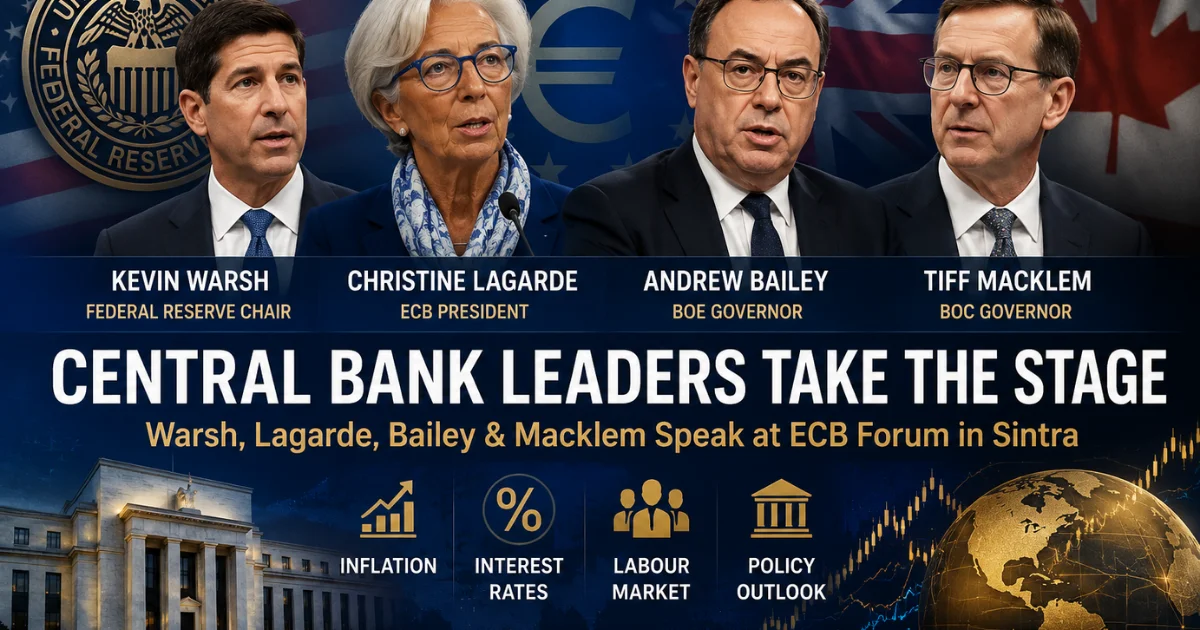
Central Bank Leaders Take the Stage: Warsh in Focus as Markets Prepare for High Volatility
Markets are preparing for an important central-bank event today as Federal Reserve Chair Kevin Warsh joins ECB President Christine Lagarde, Bank of England Governor Andrew Bailey and Bank of Canada Governor Tiff Macklem at the ECB Forum in Sintra.
The panel comes at a sensitive time for global markets.
Traders are already positioning ahead of key U.S. labour-market data, including ADP employment, ISM manufacturing and the upcoming Non-Farm Payrolls report. At the same time, markets are reassessing inflation pressure, interest-rate expectations, oil prices and the future direction of the U.S. Dollar.
The biggest focus will be on Warsh.
This is one of his first major international appearances as Fed Chair, and investors will be watching closely for clues on inflation, interest rates, the labour market and the Fed’s future communication style.
Why Today’s Panel Matters
Central-bank speeches can move markets at any time, but today’s panel has added importance because several major currencies are involved at once.
The Dollar, euro, pound and Canadian Dollar could all react depending on how each policymaker describes inflation, growth and the future interest-rate path.
The event may also create moves in Treasury yields, European bond yields, gold and equities.
The market is not necessarily expecting a direct policy announcement. But when four major central-bank leaders speak in the same discussion, even small differences in language can change expectations.
The largest market reaction is likely to come if Warsh gives a stronger message than expected on inflation or rates.
Warsh Is the Main Focus for Dollar Traders
Kevin Warsh will be closely watched because markets are still trying to understand how he intends to lead the Federal Reserve.
The Fed has recently kept rates restrictive, while the U.S. economy has continued to show resilience. Inflation has moderated from earlier highs but remains above the Fed’s long-term target. Consumer spending, income growth and labour-market conditions have also remained firm enough to keep pressure on the Fed to avoid becoming dovish too early.
This means traders will listen carefully to Warsh’s tone.
The key question is whether he sees inflation as persistent enough to justify keeping rates higher for longer.
If Warsh stresses that inflation is still too high, or says that strong demand and wages remain a concern, the market may interpret that as hawkish.
That would likely support the U.S. Dollar and push Treasury yields higher.
What Markets Will Watch From Warsh
The first issue is inflation.
Warsh has previously shown that price stability remains a priority. If he repeats that the Fed is not yet confident inflation is returning sustainably to target, markets may reduce expectations for future easing.
The second issue is the interest-rate path.
Warsh may avoid giving a direct signal about the next Fed move. His approach appears less focused on clear forward guidance and more focused on responding to incoming data.
That can make his speeches more difficult to interpret.
Traders may need to focus on his language around inflation, financial conditions and the labour market rather than wait for a direct signal about whether rates will rise, hold or fall.
The third issue is employment.
With ADP employment data due before the panel and Non-Farm Payrolls later this week, any comments from Warsh on wages, hiring or labour-market cooling could have a strong impact on the Dollar.
A firm labour market gives the Fed more room to keep rates restrictive.
A weaker labour market would create pressure for a more cautious policy approach.
The fourth issue is long-term yields and the Fed balance sheet.
If Warsh focuses on elevated Treasury yields, tighter financial conditions or the need to reduce the Fed’s balance sheet further, markets may see this as another hawkish message.
That could pressure gold and equities while supporting the Dollar.
Hawkish Warsh Scenario
The Dollar-positive scenario would be a clear focus on sticky inflation, strong demand and the need to keep policy restrictive.
In this outcome, Warsh may argue that the Fed still has work to do on inflation or that policy cannot become easier until there is more convincing evidence of price stability.
The likely market reaction could be:
- U.S. Dollar strength
- Higher Treasury yields
- Pressure on gold
- Weakness in EUR/USD and GBP/USD
- Possible upside in USD/JPY
- Pressure on AUD/USD and NZD/USD
- Softer equity-market sentiment
This would reinforce the higher-for-longer policy view.
Neutral Warsh Scenario
A neutral outcome would be Warsh repeating that the Fed remains data dependent.
He may avoid discussing the next rate move and instead focus on the uncertainty around inflation, growth, employment and global conditions.
In this case, markets may remain choppy rather than trend strongly.
The Dollar could trade in a narrow range until the next U.S. data releases provide a clearer direction.
This may be the most likely outcome if Warsh wants to avoid creating unnecessary market volatility before the employment report.
Dovish Surprise Scenario
The most Dollar-negative outcome would be Warsh focusing on slowing demand, cooling labour-market conditions or downside risks to growth.
If he suggests that lower oil prices and easing inflation pressure are reducing the need for prolonged restrictive policy, markets may begin to reduce expectations for future Fed tightening.
The likely market reaction could be:
- Dollar weakness
- Falling Treasury yields
- Gold recovery
- Strength in EUR/USD and GBP/USD
- Support for AUD/USD and NZD/USD
- Improved equity-market sentiment
However, a strongly dovish message may be difficult because recent U.S. data has still shown resilience.
Lagarde Will Decide the Euro Reaction
ECB President Christine Lagarde will be important for EUR traders.
The eurozone faces a different challenge from the United States. Inflation has eased in some areas, but services inflation and wage pressure remain important concerns for the ECB.
Markets will watch whether Lagarde keeps the door open for further tightening.
If she stresses that inflation remains too high or that the ECB cannot declare victory yet, the euro may find support.
EUR/USD could rise if Lagarde sounds hawkish while Warsh sounds cautious.
But if Warsh is more hawkish than Lagarde, the Dollar may remain in control.
The EUR/USD reaction will likely depend on the relative tone of the two central-bank leaders rather than either speech alone.
Bailey Will Be Important for Sterling
Bank of England Governor Andrew Bailey will be the key figure for GBP traders.
The pound remains sensitive to UK inflation, wage growth and services prices. The Bank of England has been cautious because inflation has not fully returned to target, while UK growth remains fragile.
If Bailey highlights wage pressure and persistent services inflation, GBP may find support.
If he focuses more on weak growth, households under pressure or falling inflation, markets may take a more dovish view.
GBP/USD will be especially sensitive because it will reflect both Bailey’s tone and Warsh’s comments.
A hawkish Bailey and neutral Warsh could support the pound.
A cautious Bailey and hawkish Warsh could pressure GBP/USD lower.
Macklem and the Canadian Dollar
Bank of Canada Governor Tiff Macklem will matter for CAD traders.
Canada is dealing with a different mix of risks, including slower growth, household debt pressure, trade uncertainty and the recent movement in oil prices.
Macklem may focus on how lower oil prices affect inflation, how domestic demand is performing and whether the Bank of Canada can remain patient.
A stronger Canadian growth message may support CAD.
But the Canadian Dollar will also remain heavily influenced by oil prices and the broader U.S. Dollar trend.
USD/CAD may therefore react more to the combination of Macklem’s comments, oil moves and Warsh’s tone.
Will Markets Be Volatile?
Yes, volatility is possible.
The panel combines four major central-bank leaders at a time when markets are already positioned ahead of important U.S. employment data.
The event may create sharp short-term moves, particularly if one policymaker sounds clearly more hawkish or dovish than expected.
The biggest volatility risk comes from Warsh because the market is still learning how he communicates as Fed Chair.
A more direct inflation warning could lift the Dollar quickly.
A cautious message on growth or labour conditions could trigger a Dollar pullback.
The risk is also higher because traders may react to headlines before hearing the full discussion.
This can create false breakouts and fast reversals.
Markets to Watch During the Panel
The first market to monitor will be the U.S. Dollar Index.
If DXY rises alongside U.S. two-year Treasury yields, markets are likely interpreting Warsh as hawkish.
For EUR/USD, watch the balance between Warsh and Lagarde.
For GBP/USD, watch whether Bailey sounds more concerned about inflation or growth.
For USD/CAD, monitor oil prices alongside Macklem’s comments.
Gold will be highly sensitive to the reaction in yields and the Dollar.
If yields rise, gold may come under pressure.
If yields fall, gold may recover.
BonusPips View
Today’s central-bank panel has the potential to create meaningful volatility across forex, gold and equity markets.
The main focus will be Kevin Warsh because his comments may shape expectations ahead of key U.S. labour-market data.
A hawkish Warsh could strengthen the Dollar, lift Treasury yields and pressure gold. A neutral speech may keep markets range-bound until the next data releases. A dovish surprise could trigger a Dollar pullback and support risk-sensitive currencies.
Lagarde, Bailey and Macklem will also matter, especially for EUR, GBP and CAD pairs.
The key message is simple:
Today’s event is less about formal policy decisions and more about policy tone. The market will be listening for clues on inflation, labour conditions, interest rates and how long central banks may keep policy restrictive.
Traders should expect headline-driven volatility and avoid chasing the first market move without confirmation from Treasury yields and price action.


0 Comments