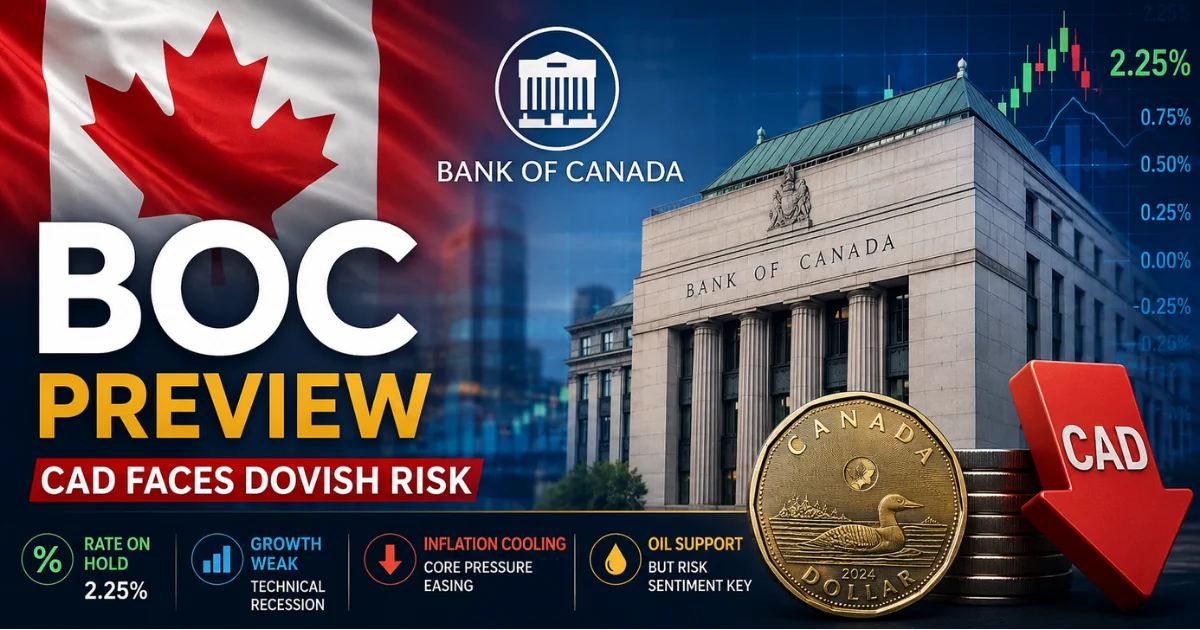
Bank of Canada Preview: CAD Faces Pressure as BoC Expected to Lean Dovish
The Canadian Dollar is in focus as traders wait for the Bank of Canada rate decision, statement and press conference. The market is not expecting a change in the overnight rate, which is expected to remain at 2.25%. The bigger question is not the rate decision itself, but the message from the Bank of Canada.
The Canadian Dollar has been struggling because the domestic economic picture is not strong enough to support a hawkish central bank stance. Inflation has not been as strong as feared, the labour market remains uneven, growth is weak, and trade uncertainty with the United States is still creating pressure.
This means the Bank of Canada may keep rates unchanged but still sound cautious and dovish.
What Is Expected From the Bank of Canada?
The Bank of Canada is expected to hold the overnight rate steady at 2.25%.
Markets will focus on three things:
The rate statement
Governor Tiff Macklem’s press conference
Any signal about future rate cuts or hikes
The central bank is unlikely to sound aggressive because the Canadian economy is not giving enough support for a hawkish shift. Even though energy prices remain elevated, the broader economic backdrop is soft.
The BoC may acknowledge inflation risks, but it is also likely to highlight weak growth, trade risks and labour-market uncertainty.
Why the BoC May Stay Dovish
Canada’s inflation picture has not forced the central bank to become more aggressive. Headline inflation rose, but not as much as markets had feared, while core inflation showed signs of slowing.
This gives the BoC room to avoid a hawkish message.
The labour market is also mixed. Canada saw a strong rebound in employment in May, but the unemployment rate remains elevated. This shows that the economy is not clearly strong enough to justify higher interest rates.
Growth is another concern. Canada has moved into a technical recession after weak GDP readings. This is important because a central bank cannot ignore weak economic activity, even if inflation is still above comfort levels.
The BoC also has to consider trade uncertainty. Any pressure from changes in the USMCA trade relationship could hurt Canadian growth further. That makes the central bank more careful about tightening policy too soon.
Why CAD May Remain a Laggard
The Canadian Dollar is usually supported by higher oil prices because Canada is a major energy producer. But this time, the oil story may not be enough to lift CAD strongly.
The reason is simple.
If oil prices rise because of geopolitical stress, global risk sentiment may weaken. In that case, investors may prefer the safe-haven U.S. Dollar instead of buying the Canadian Dollar.
So even though higher oil can support Canada’s terms of trade, the risk-off environment can still keep CAD under pressure.
This is why CAD may continue to lag other commodity currencies if the BoC remains dovish and the U.S. Dollar stays supported by higher yields.
USD/CAD Outlook
USD/CAD remains the most important pair to watch around the BoC decision.
If the BoC keeps rates unchanged and sounds dovish, USD/CAD may remain supported. A cautious BoC statement can increase the policy gap between the Federal Reserve and the Bank of Canada, especially if U.S. inflation and jobs data keep the Fed hawkish.
In this case, USD/CAD can move higher, with traders watching the 1.40 area as an important psychological zone.
If the BoC sounds less dovish than expected, USD/CAD may pull back. But for a stronger CAD recovery, the market would need more than just a neutral statement. It would need better Canadian growth, stronger inflation pressure, or softer U.S. Dollar conditions.
CAD/JPY Outlook
CAD/JPY will depend on two major forces: oil prices and global risk sentiment.
If oil prices stay strong and risk sentiment remains stable, CAD/JPY may find support. But if geopolitical tension hurts market confidence, JPY safe-haven demand could increase and pressure CAD/JPY lower.
A dovish BoC would also limit CAD/JPY upside because lower Canadian yield expectations reduce support for the Canadian Dollar.
For now, CAD/JPY may remain volatile and headline-sensitive.
EUR/CAD Outlook
EUR/CAD may remain supported if the BoC leans dovish while European currencies benefit from improved global sentiment or lower energy stress.
If oil prices fall because of de-escalation in the Middle East, CAD may not benefit much, while European currencies could gain from lower energy costs. That could support EUR/CAD.
However, if oil prices rise sharply and risk sentiment does not collapse, CAD could still find some short-term support against the euro.
Overall, EUR/CAD may stay bid if the BoC sounds cautious.
GBP/CAD Outlook
GBP/CAD may also remain supported if the Bank of Canada sounds more dovish than the Bank of England.
The pound has its own domestic risks, but if UK rate expectations stay firmer than Canadian rate expectations, GBP/CAD can continue to attract buyers on dips.
A dovish BoC statement would make it difficult for CAD to outperform GBP unless oil prices rise strongly and global sentiment remains stable.
AUD/CAD and NZD/CAD Outlook
AUD/CAD and NZD/CAD may become more interesting if CAD remains weak.
If global risk sentiment improves, AUD and NZD may outperform CAD because they are more sensitive to risk appetite and China-linked demand. CAD may lag because Canada’s domestic story is weaker and the BoC remains cautious.
However, if oil prices rise sharply while commodity sentiment improves, CAD may perform better against AUD and NZD.
The main driver will be whether oil strength comes from healthy demand or from geopolitical fear. Demand-driven oil strength is better for CAD. Fear-driven oil strength may not help CAD much.
What Traders Should Watch in the Statement
The market will focus on whether the BoC sounds more worried about inflation or growth.
If the statement focuses on inflation risk, CAD may recover.
If the statement focuses on weak growth, labour-market softness and trade uncertainty, CAD may weaken.
Traders should also watch Governor Macklem’s press conference. If he says future rate cuts cannot be ruled out, CAD could come under pressure. If he pushes back against rate-cut expectations and sounds more balanced, CAD may stabilize.
BonusPips View
The Canadian Dollar is facing a difficult setup.
The BoC is expected to hold rates steady, but the tone may remain dovish because Canada’s economy is not strong enough to justify a hawkish shift. Inflation has not been as hot as feared, the labour market is mixed, and growth is weak.
This keeps CAD vulnerable, especially against the U.S. Dollar.
USD/CAD may remain supported if the BoC sounds cautious and the Fed remains firm. CAD crosses may also struggle unless oil prices rise in a way that improves Canada’s outlook without damaging global risk sentiment.
The key point is simple:
CAD needs a stronger domestic story to outperform. Right now, the market sees a cautious BoC, weak growth, and uncertainty around trade policy.
Unless the Bank of Canada surprises with a more confident tone, CAD may remain one of the weaker commodity currencies in the near term.



0 Comments