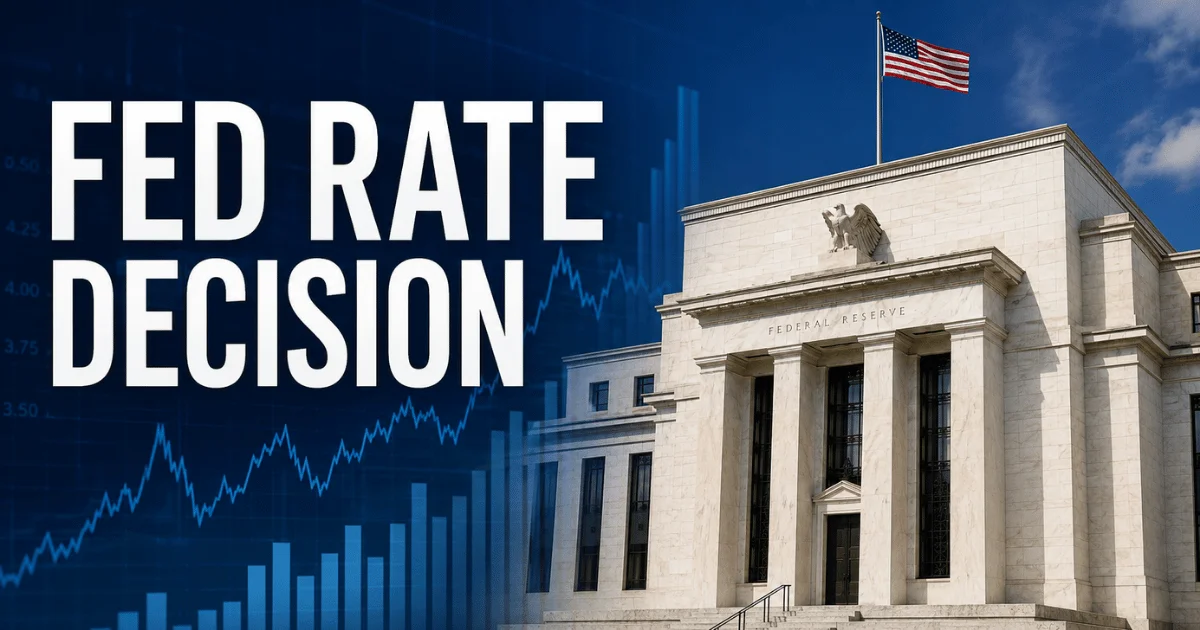
Fed Rate Decision Preview: Warsh’s First FOMC Meeting Could Reset Dollar Expectations
The Federal Reserve is in focus today as markets prepare for the first policy decision under new Fed Chair Kevin Warsh. The rate decision itself is not expected to bring a surprise, but the statement, projections and press conference could create strong movement across the U.S. Dollar, gold, stocks, bonds and major forex pairs.
Markets are expecting the Fed to keep the federal funds rate unchanged in the 3.50%–3.75% range. The real question is not whether the Fed holds today. The real question is whether the Fed keeps a neutral tone, removes its easing bias, or starts preparing markets for possible rate hikes later this year.
This is why today’s FOMC decision is important.
It is not only a rate decision. It is also the first major test of how Kevin Warsh wants to lead the central bank.
What Markets Are Expecting
The base case is a rate hold.
The Fed is expected to keep rates unchanged because policy is already restrictive and the committee may want more evidence before making another move. However, the inflation backdrop has changed. Energy prices have been volatile due to Middle East tensions, oil remains important for inflation expectations, and recent U.S. data has not been weak enough to force the Fed into a dovish position.
This means the Fed can hold rates, but still sound hawkish.
Markets will focus on three things:
The FOMC statement
The updated economic projections
Warsh’s press conference
The rate decision may be the least important part of the event.
Why This Meeting Matters More Than Usual
This meeting is important because it is Kevin Warsh’s first meeting as Fed Chair.
Markets are watching whether he changes the Fed’s communication style. Warsh has previously been associated with a preference for less forward guidance, which means the Fed may avoid giving markets a clear promise about the next move.
That can increase volatility.
Under previous Fed leadership, markets often looked for direct clues in the statement. If Warsh moves toward a more flexible communication style, traders may need to rely more on the data and less on Fed guidance.
This can make the Dollar, yields and gold more reactive after every major inflation or jobs report.
The Big Question: Does the Fed Remove the Easing Bias?
One of the most important things to watch is whether the Fed removes language that suggests the next move could be a cut.
If the Fed removes its easing bias, markets may treat that as hawkish even if rates stay unchanged.
That would mean the Fed is no longer preparing investors for easier policy. Instead, it may be moving toward a neutral or even slightly hawkish stance.
This would support the U.S. Dollar and Treasury yields.
If the Fed keeps an easing bias, the market may see that as softer than expected. In that case, the Dollar may weaken and gold may recover.
Inflation Is Still the Main Problem
Inflation remains the biggest reason the Fed cannot sound dovish.
Oil prices have been volatile because of the U.S.-Iran conflict and Strait of Hormuz risk. Even after peace-deal headlines reduced some pressure, energy markets remain sensitive. If oil rises again, inflation expectations can move higher quickly.
The Fed will not want to ignore that risk.
Sticky inflation, stronger energy prices and resilient jobs data all make it difficult for the Fed to signal rate cuts. This is why markets are now discussing whether the Fed may need to keep rates high for longer or even consider another hike later this year.
That is a major shift from the earlier expectation of cuts.
What the Dot Plot Could Show
The dot plot will be one of the most closely watched parts of today’s decision.
If the dot plot shows policymakers moving away from rate cuts, the market may treat the meeting as hawkish.
If some members pencil in a rate hike later this year, the Dollar may rally sharply.
If the dot plot still shows future cuts, then the market reaction may be softer, especially if Warsh does not push back strongly during the press conference.
The dot plot matters because it shows how divided or unified the Fed is.
A divided Fed can create volatility. A clearly hawkish dot plot can support the Dollar. A softer dot plot can support gold and equities.
Scenario 1: Fed Holds but Sounds Hawkish
This is the most Dollar-positive scenario.
The Fed holds rates steady but removes the easing bias, raises inflation projections, keeps growth stable, and warns that inflation risks remain elevated.
In this case, markets may price a higher chance of a future hike.
Possible market reaction:
The U.S. Dollar strengthens
Treasury yields rise
Gold and silver come under pressure
Stocks may weaken
EUR/USD and GBP/USD may fall
USD/JPY may push higher
Risk-sensitive currencies may struggle
This scenario becomes more likely if Warsh says inflation is still too high and the Fed must stay flexible.
Scenario 2: Fed Holds and Sounds Neutral
This is the balanced scenario.
The Fed keeps rates unchanged, removes strong guidance, and says future decisions will depend on incoming data. Warsh avoids committing to cuts or hikes.
In this case, the market reaction may be choppy.
The Dollar may initially move both ways as traders interpret the statement and press conference. Gold may also remain volatile, especially if yields do not move clearly.
This scenario would keep markets focused on future CPI, PPI, PCE, jobs and wage data.
Scenario 3: Fed Holds but Sounds Dovish
This would be the most risk-positive scenario.
If the Fed keeps an easing bias or sounds more worried about growth than inflation, markets may price lower future rates.
Possible market reaction:
The U.S. Dollar weakens
Treasury yields fall
Gold and silver recover
Stocks rally
EUR/USD and GBP/USD move higher
AUD/USD and NZD/USD benefit from risk appetite
USD/JPY may fall
This scenario would require Warsh to sound comfortable with inflation trends or more concerned about growth risks.
At this stage, that may be difficult because inflation remains above target and energy risk has not fully disappeared.
Impact on the U.S. Dollar
The Dollar is at an important point.
Recently, the Dollar has been supported by Fed-rate expectations, safe-haven flows and strong U.S. data. But peace-deal optimism around Iran has reduced some safe-haven demand.
This means the Fed decision can decide whether the Dollar regains strength or continues to soften.
A hawkish Fed can restart the Dollar rally.
A neutral Fed may keep the Dollar range-bound.
A dovish Fed can trigger a deeper Dollar pullback.
For DXY, the key driver will be Treasury yields after the press conference.
Impact on EUR/USD
EUR/USD will react directly to the Fed tone.
If Warsh sounds hawkish and U.S. yields rise, EUR/USD may struggle and move back toward support.
If the Fed sounds neutral or dovish, EUR/USD may recover, especially if the ECB remains relatively firm on inflation.
The key for EUR/USD is whether the pair can hold above recent support and break through resistance after the Fed.
A hawkish Fed supports the Dollar.
A softer Fed supports the euro.
Impact on GBP/USD
GBP/USD will be driven by the Fed first and then the Bank of England.
If the Fed sounds hawkish, GBP/USD may fall even if UK data remains firm.
If the Fed sounds softer, GBP/USD may recover before the BoE decision.
The pound also has domestic drivers this week, including UK inflation, wages and retail sales, but today’s Fed decision can set the first major direction.
Impact on USD/JPY
USD/JPY may be one of the most sensitive pairs.
Japan’s Ministry of Finance is already facing intervention pressure because the yen remains weak. At the same time, the Bank of Japan is moving toward tighter policy.
If the Fed sounds hawkish and U.S. yields rise, USD/JPY may push higher and increase intervention risk.
If the Fed sounds softer and yields fall, USD/JPY may drop as yen buyers return.
This pair can move sharply after the Fed because it is highly sensitive to yield spreads.
Impact on AUD/USD and NZD/USD
AUD/USD and NZD/USD are risk-sensitive.
If the Fed sounds hawkish, both pairs may come under pressure because a stronger Dollar and higher yields usually hurt risk currencies.
If the Fed sounds softer, AUD and NZD may recover, especially if global risk sentiment remains supported by the Iran peace framework.
For AUD, the RBA hold is already known. For NZD, risk appetite and U.S. Dollar direction may matter more in the short term.
Impact on Gold
Gold is one of the most important markets to watch after the Fed.
Gold has been under heavy pressure recently because the Dollar and Treasury yields have remained firm. Even geopolitical tension did not create a sustained gold rally because the market focused more on rate expectations.
If the Fed sounds hawkish, gold may face renewed selling pressure.
If the Fed sounds neutral or dovish, gold may recover because yields could fall and the Dollar may weaken.
For gold, the key is not just the rate decision. The key is the movement in real yields after Warsh’s press conference.
Impact on Stocks
Equities may react sharply to the Fed’s tone.
A hawkish Fed can pressure stocks because it keeps borrowing costs high and reduces hopes for easier policy.
A neutral Fed may keep stocks stable but cautious.
A dovish Fed can support equities, especially technology and growth shares, because lower yields improve valuations.
However, if Warsh removes forward guidance and creates more uncertainty, stocks may become volatile even without a rate change.
What Traders Should Watch After the Decision
The first move after the rate decision may not be the real move.
The market often reacts first to the statement, then again to the press conference. Traders should avoid judging the full reaction too quickly.
The most important things to watch are:
Whether the Fed removes its easing bias
Whether inflation projections move higher
Whether the dot plot shows hikes, holds or cuts
Whether Warsh sounds hawkish or balanced
How Treasury yields react
How the Dollar index reacts
Whether gold breaks or holds key support
Whether equities sustain the first reaction
The press conference can easily reverse the first market move.
BonusPips View
Today’s Fed decision is one of the most important events of the week.
The rate hold is almost fully expected. The real market driver will be Kevin Warsh’s tone, the updated projections and whether the Fed removes its easing bias.
If the Fed signals that inflation risks remain too high and rate cuts are no longer the base case, the Dollar may strengthen and gold may come under pressure again.
If the Fed sounds balanced or less hawkish, the Dollar may soften, gold may recover and risk assets may extend gains.
The key message is simple:
Today is not about the rate decision. It is about whether the Fed changes the policy direction under Kevin Warsh.
Traders should focus on post-news confirmation, not the headline rate hold. The strongest opportunities may come after the press conference, once the market decides whether Warsh’s first Fed meeting is hawkish, neutral or dovish.


0 Comments